What Is Generative AI, Really?
Ever wondered why Generative AI (GenAI) is suddenly everywhere? It’s become a buzzword in the tech world, captivating businesses, developers, and everyday users alike. More than just hype, it’s a transformative technology reshaping how we interact with machines and digital content.
Unlike traditional AI—which focuses on analyzing and interpreting data—generative AI is all about creation. This kickoff post will delve into what generative AI is, how it breaks the mold of conventional AI, its most exciting breakthroughs, and where it’s headed next.
This blog series will guide you from the basics to the most advanced topics in generative AI, with practical, real-world applications at every step.
🚀 GenAI: Welcome to the Age of “Generative Intelligence”
Generative AI refers to algorithms that don’t just analyze data—they create it. Or in other words they ‘generate’ it. These models learn patterns from vast datasets and use that knowledge to generate new outputs. Well… some might challenge the word ‘original’, so let’s say it produces modified, remixed, or reimagined content 😄.

Its ability to generate text, images, music, code, and more has unlocked a world of possibilities—making it one of the most talked-about technologies today.
🔄 But, AI Has Been Around for Decades—So What Changed?
While AI has long been part of technological progress, recent leaps in computational power and data availability have catapulted generative AI into the spotlight.
The real game-changer? Deep learning breakthroughs, especially transformer-based models, which dramatically improved AI’s ability to understand and generate human-like content.
🤖 How Does Generative AI Differ from Traditional AI?
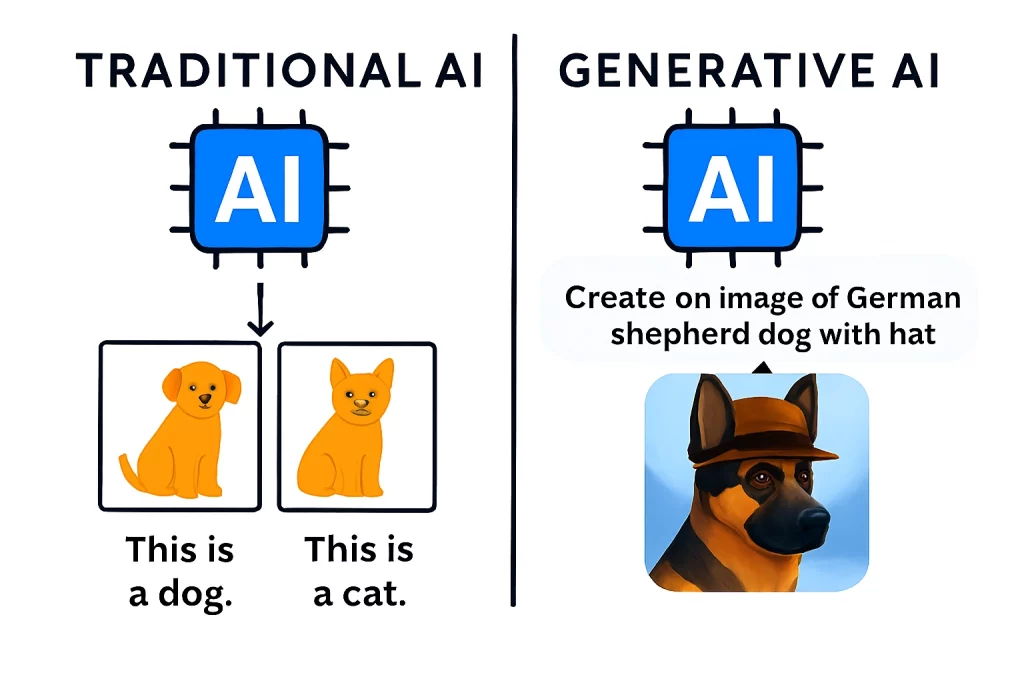
Traditional AI focuses on tasks like classification, prediction, and decision-making. It analyzes labeled data and outputs categories or probabilities.
Generative AI flips the script—it creates entirely new data. For example, traditional AI can identify whether an image is a dog or a cat. Generative AI? It can generate a dog based on your description—and even put a cap on its head 😄. This creative capability opens doors to applications in art, design, storytelling, and beyond.
🎨 Capabilities of Generative AI
Generative AI is already transforming industries with its wide-ranging abilities:
- Content Creation: Generates realistic images, videos, music, and written content.
- Design & Art: Helps artists and designers explore new creative directions.
- Virtual Worlds: Builds immersive environments in gaming and VR.
- Data Augmentation: Produces synthetic data to enhance machine learning models.
- Coding: Automates code generation, builds tools, and even entire websites.
And the list continues…
📈 But, What Truly Sparked the GenAI Explosion?
While AI has been part of technological progress for decades, recent breakthroughs in generative AI have propelled its development to new heights. The journey of GenAI arguably began in the 1960s with early chatbots like ELIZA, but until 2017, most AI models struggled with long-range context and scalability.
That changed in 2017 with the introduction of the Transformer architecture—a breakthrough that redefined what AI could do. It allowed models to process massive datasets efficiently and understand nuanced relationships in language, images, and more.

AI is the umbrella →
Machine Learning is how AI learns →
Deep Learning is how ML gets smarter →
Generative AI is Deep Learning that creates.
🧭 A Timeline of Important GenAI Breakthroughs

🌍And, Suddenly Generative AI Is Everywhere …
GenAI has moved from research labs to everyday life. It’s quietly powering how we work, learn, shop, and create:
- At work: Drafts emails, builds presentations, summarizes meetings, writes code.
- In classrooms: Tutors students, assists teachers, generates lesson plans.
- On your phone: Powers chatbots, voice assistants, and personalized recommendations.
- In entertainment: Composes music, writes stories, creates videos.
- In marketing & design: Crafts ad copy, designs visuals, generates logos.
- In shopping: Curates products, designs fashion, tailors ads.
- In healthcare: Analyzes data, generates reports, personalizes wellness plans.
And the list keeps growing…
🚀 So Where Is It Really Heading & What’s the Ultimate Goal?
The ultimate ambition behind generative AI isn’t just smarter tools—it’s Artificial General Intelligence (AGI): machines with human-level flexibility across tasks. While today’s models excel in narrow domains, they still lack the broad adaptability and self-directed learning that define true general intelligence. But we are not too far from it, especially considering the vast amount of development on each passing day—across the world.
Each breakthrough in creative reasoning nudges us closer to that horizon. For now, we’re working with powerful narrow intelligence—impressive, but not yet the full picture.
🤔 Then, Should I Be Scared, That GenAI Will Replace Me?
It’s a hot topic—and a valid concern. Yes, generative AI can automate tasks and disrupt traditional roles. But it also opens doors to new opportunities, enhances productivity, and empowers people to do more with less.
The key lies in adaptation: learning to work alongside AI, using it to amplify your skills rather than compete with it. As the saying goes:
“AI won’t replace you—but the person who knows how to use AI might.”
We’ll explore this aspect in more depth throughout the blog series, so stay tuned.
📚 What’s Covered in This Series—and What’s in the Next Post?
This blog series will unpack the full spectrum of generative AI—from foundational concepts to frontier innovations like agentic AI, Model Context Protocols (MCPs), and agent-to-agent collaboration.

In the next post, we’ll zoom in on what makes generative AI truly ‘GENERATE’—through the lens of an architect. If you’re curious about how these systems are designed to think, create, and collaborate, you won’t want to miss it.
✨ Conclusion: Embracing the Creative Future
Generative AI isn’t just advancing technology—it’s redefining creativity. As we unlock new ways to imagine, design, and communicate, the real question becomes: Will you harness this power as a companion—or fear it as a rival?
Stay tuned as we venture into the uncharted territories of this fascinating technology in the blogs to come.
👉 Feel free to subscribe to receive free updates as each post drops.